
This Must Be the Place: Celebrating 60 Years of Community Organizing at UPROSE, Sunset Park’s Oldest Climate Justice Organization
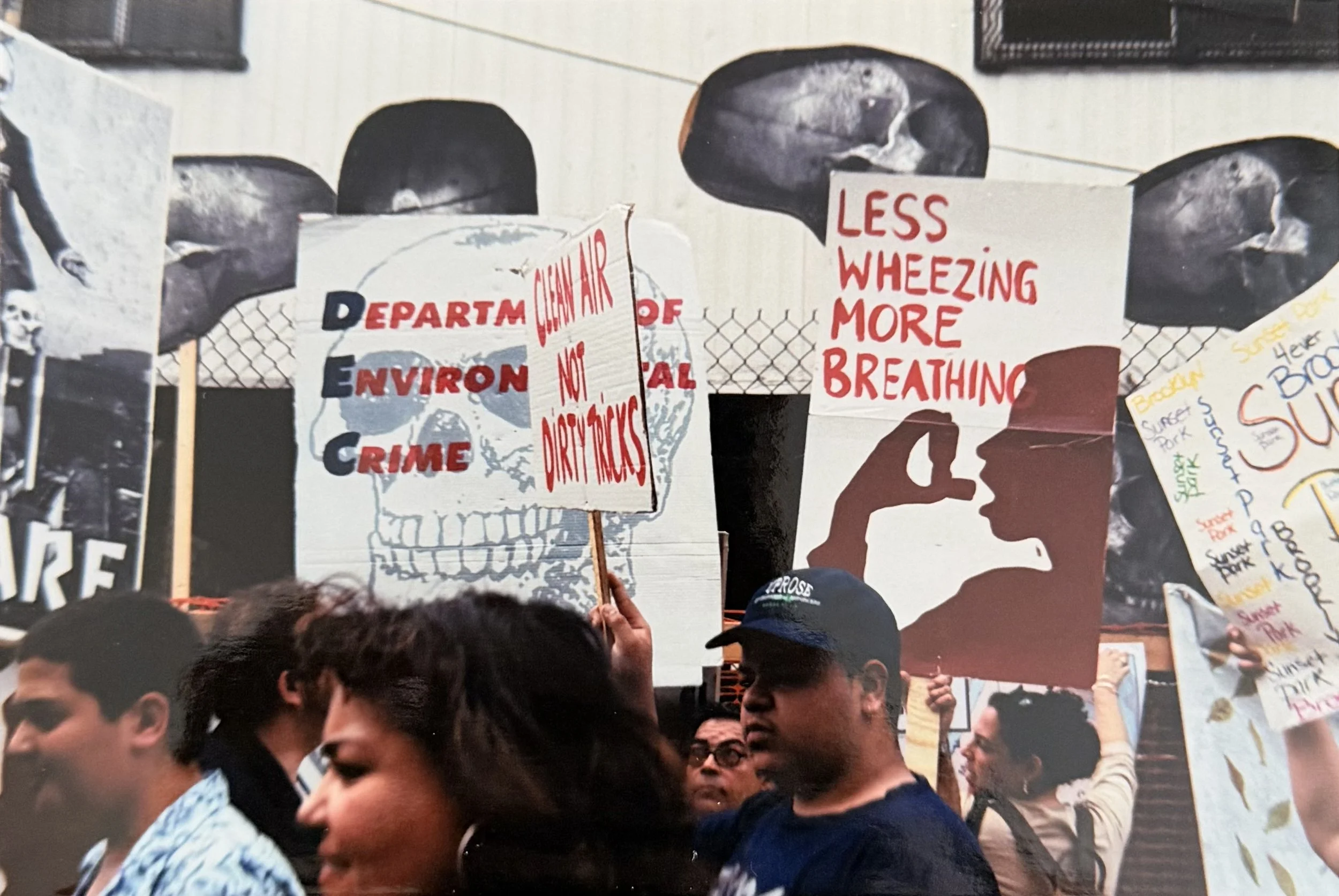
An intergenerational group marches to protest increased traffic in Sunset Park in the early 2000s. Photo courtesy of UPROSE.
Nearly twenty years ago, 14-year-old Brian Gonzalez began wondering why he was always sick. He had stomach issues, epilepsy, and persistent respiratory problems. He wasn’t an anomaly: Nearly everyone in his neighborhood had asthma or a sibling who did. Brian’s older sister, Crystal, suspected that the family’s proximity to the Gowanus Expressway was a large part of—if not the problem itself. A Google search led her to UPROSE, a Scherman Foundation grantee for more than a decade and a community development organization that did some work on “garbage” and “transportation.”
When the Gonzalez siblings arrived at UPROSE in the aughts, the focus had shifted and what they found was not your father’s traditional environmental organization. Instead, UPROSE was matriarchal, intergenerational, multiracial, and multi-ethnic.
“Youth are integrated into everything we do, but people don’t phase out,” said Gonzalez, noting that he is still an organizer and now a board member, too. “There’s a role for everyone.”
At UPROSE’s helm was Elizabeth Yeampierre, who became executive director in 1996, inheriting an organization plagued by problems—from economic disinvestment to a leadership gap to bankruptcy. It was time, she said, to transform a conventional, top-down, patriarchal social service organization into a place filled with organizers of all ages, food, art, children, and shared decision making.
“As a matter of pride, I couldn’t let Sunset Park’s oldest grassroots Puerto Rican organization die,” said Yeampierre, whose childhood was marked by displacement, including being pushed to the South Bronx while it was burning. “I knew we could create something that staffs the community and evolves based on what local people prioritize.”
Her conviction caused some concern.
“My mom would call me crying and say, ‘You’re a lawyer! What are you doing? You’re not going to get paid. We don’t come from money.’”
Yeampierre became an attorney under Reagan and cut her teeth as a civil rights litigator. It’s easy to imagine her squelching maternal concern with a smile on her face, bangles jangling on her arms, and hair tied up in the bright headdress that is her signature.
“I said, ‘Mom, watch what we’re gonna do. We’re going to kick ass.’ The next thing I knew she was answering phones and mayor of the block. We had a tiny little store front, and it was packed. Older people would come in at lunch with their knitting needles and tell stories. And then the young people came and asked what we did. I said, ‘Well, what do you want to do?’”
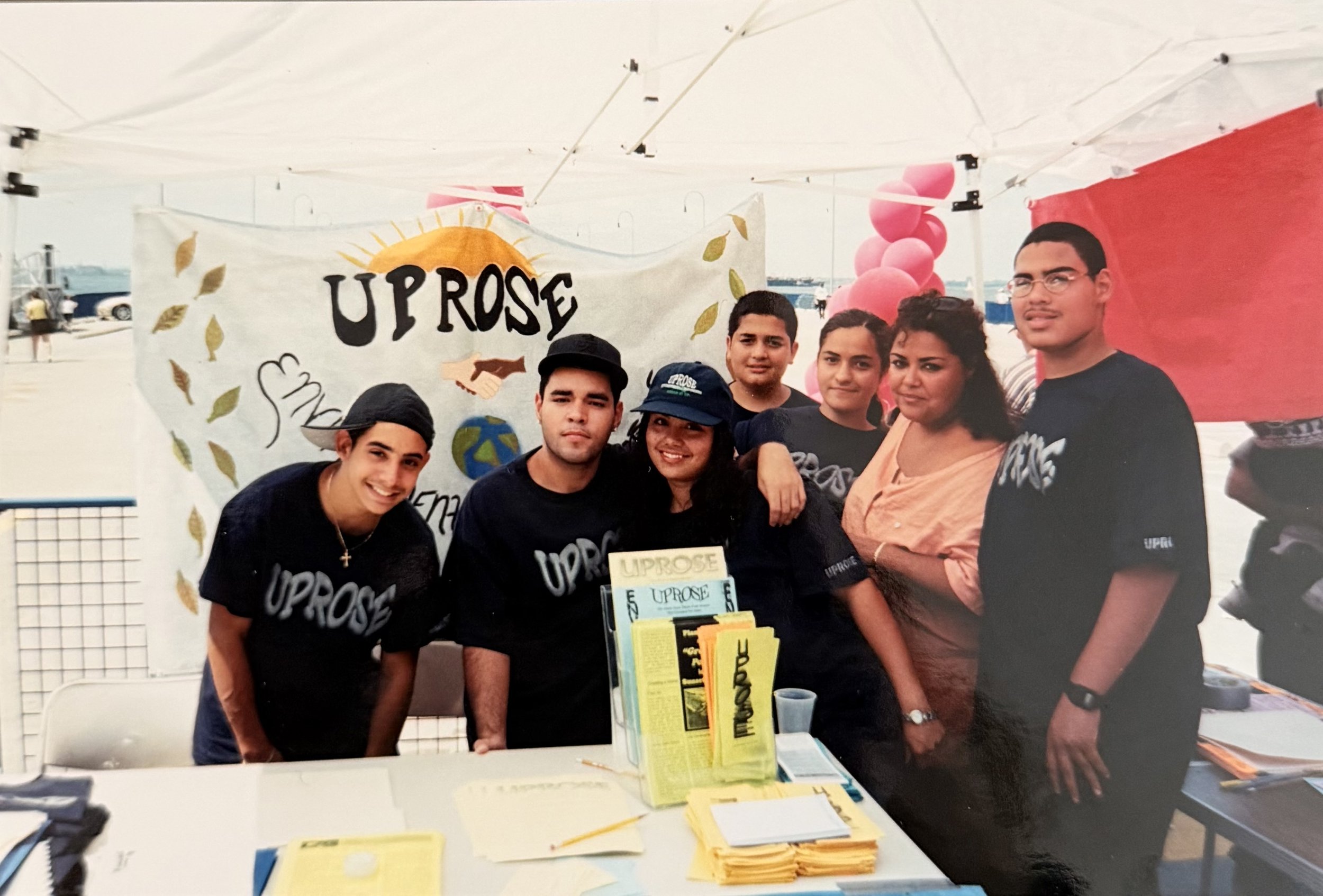
Elizabeth Yeampierre (in pink) and youth organizers offer outreach materials. Photo courtesy of UPROSE.
Do the Right Things
Breathing was top of the agenda.
Intense pollution from the Gowanus Expressway, lead paint exposure, and complacent elected officials complicated the most elementary human right. UPROSE began organizing, held town halls, and convinced their Sunset Park representative to support lead paint abatement legislation. They also halted plans to expand the expressway.
“This did not start with me being an environmentalist,” said Yeampierre, who now uses a walker and proudly describes herself as one of UPROSE’s elders. “The issues came to us, and we made UPROSE a place that everyone sees as their house.”
One issue was Sunset Park’s childhood obesity rate, which was exacerbated by insufficient green space. While working to address both—a former brownfield site was eventually transformed into the 22-acre Bush Terminal Park—UPROSE faced fresh threats. In 2003, for example, developers proposed Sunset Energy Fleet, a 520-megawatt power plant the size of three football fields. The project, which was slated to be built across from a residential street, would bring peaker plants, further pollute the neighborhood, and add to environmental disease. UPROSE pivoted from its work to create green spaces and entered the energy space. It fought against the site, noting the potential for environmental burdens and began exploring alternatives like renewable energy. The Fleet was shut down, and the organization began to think about wind and solar energy, which emit little to no greenhouse gases.
“We leaned into things organically,” said Yeampierre. “And then we started winning. And winning is addictive.”
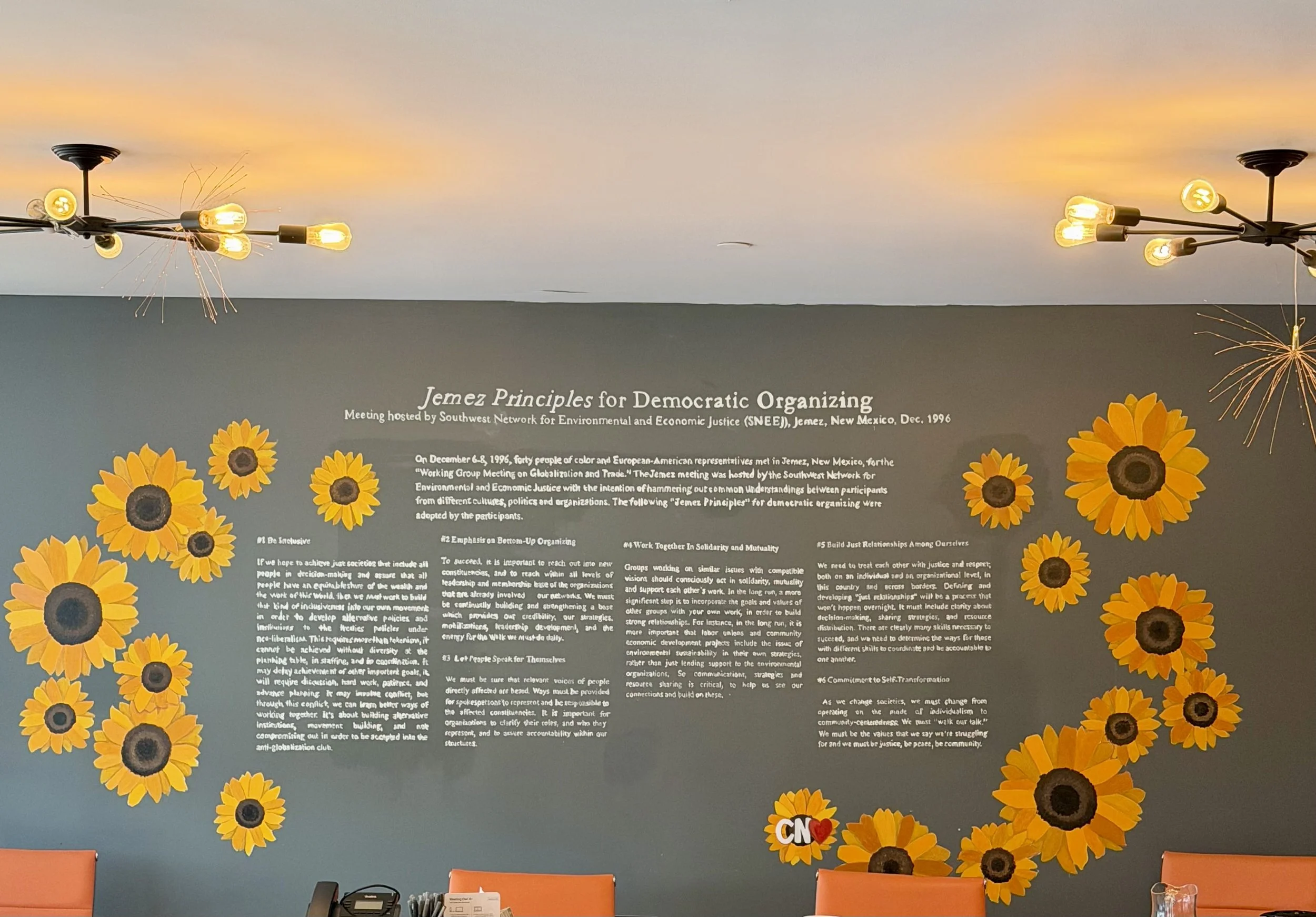
The Jemez Principles for Democratic Organizing adorn a large wall in UPROSE’s conference room.
A Community of Care
Today UPROSE is in its sixth decade and its third space under Yeampierre. It has addressed and ameliorated an almost endless list of community concerns.
“This is the first time I’ve been in a place that feels genuinely impactful and that truly incorporates the community in real ways,” said Laureen Makar, UPROSE’s Just Transition coordinator. “With traditional policy work, the people experiencing the problems aren’t involved in decision-making and have good reason to question the government agencies leading it.”
This is where art comes in.
Javier Bautista, a third-generation Puerto Rican activist, came to UPROSE as a teenager after encountering powerful murals about asthma. Now in his mid-thirties, he is director of creative and special projects. In addition to filmmaking, he leverages a variety of other mediums to highlight how environmental and climate issues exacerbate inequality.
“Some people show up for a protest, but that’s hard for parents working two jobs. We eventize our art to meet people where they’re at,” he explained. “They come for the free food and the poetry, but they walk away having learned about a campaign. Then we get them on our mailing list. And they keep coming back.”
On a warm September Saturday UPROSE held “move for movement.” People spent hours learning about land use, zoning, the benefit of becoming a special purpose district, and green reindustrialization. Then they did the cumbia, a Colombian dance that blends Indigenous, African, and Spanish influences.
“We created a community of care,” said Yeampierre, who told the story of an autistic young person whose confidence soared from participating in UPROSE’s cultural events. “You can’t organize without art. It’s how we reach people’s hearts and minds.”
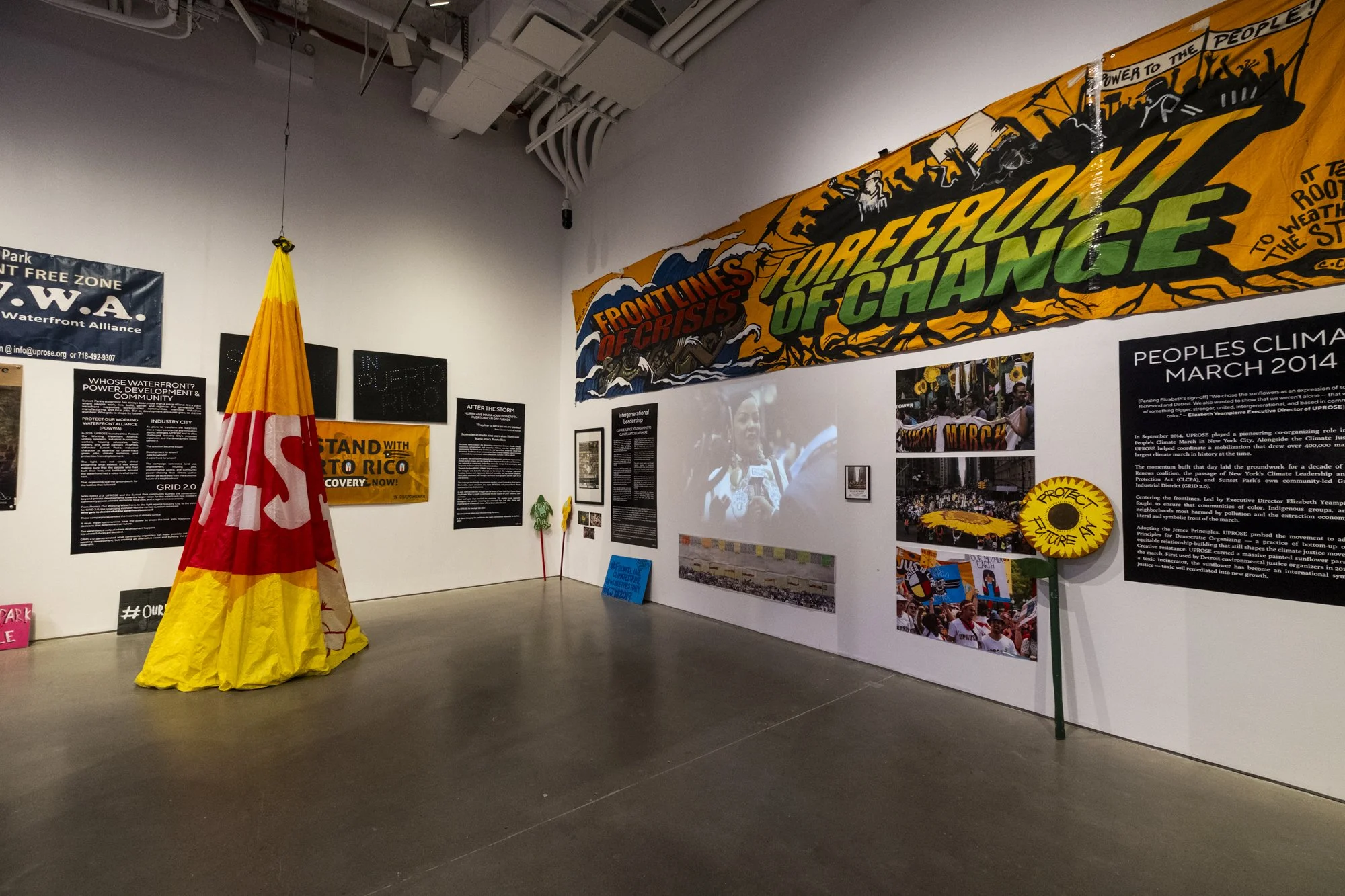
The art exhibit at UPROSE’s 60th anniversary gala showcased how creativity catalyzes movements. Photo courtesy of UPROSE.
Here Comes the Sun
In a moment where the presidential pen eviscerates longstanding environmental protections, frontline communities like Sunset Park face a range of challenges. This includes everything from AI to fierce competition for dwindling resources to philanthropy’s preference for “Big Green” environmental organizations led by white men.
Yeampierre tries to stay steady and devotes significant mental real estate to imagining what success looks like—both today and in the next sixty years.
“Solutions are local,” Yeampierre said. “We see change happen in real time. Block by block. The community is our brain trust, and the auntie on the corner is our greatest asset. She knows who’s on a respirator. Who’s on dialysis. She is our first responder. And she’s the person who will block the impact of extreme weather and manage it when it comes.”
By all accounts, UPROSE is still “kicking ass,” according to infrastructure coordinator Ahmad Perez, who led work on Sunset Park Solar, New York City’s first community-led solar project. Owned and operated by UPROSE and the clean energy developer Working Power, the project went live in August; it provides subscribers, including 200 families and local restaurants like the Latino-owned fully electric Savo, with a 20% reduction in their energy bill. Enrollment is free. Anyone in the community can sign up. And because subscribers tap into solar panels on the Brooklyn Army Terminal rooftop, they don’t need to install anything to reduce their costs and cut greenhouse gas emissions.
“There is so much chaos right now,” said Perez, “but it’s really something to live in a city that’s giving people some relief.”
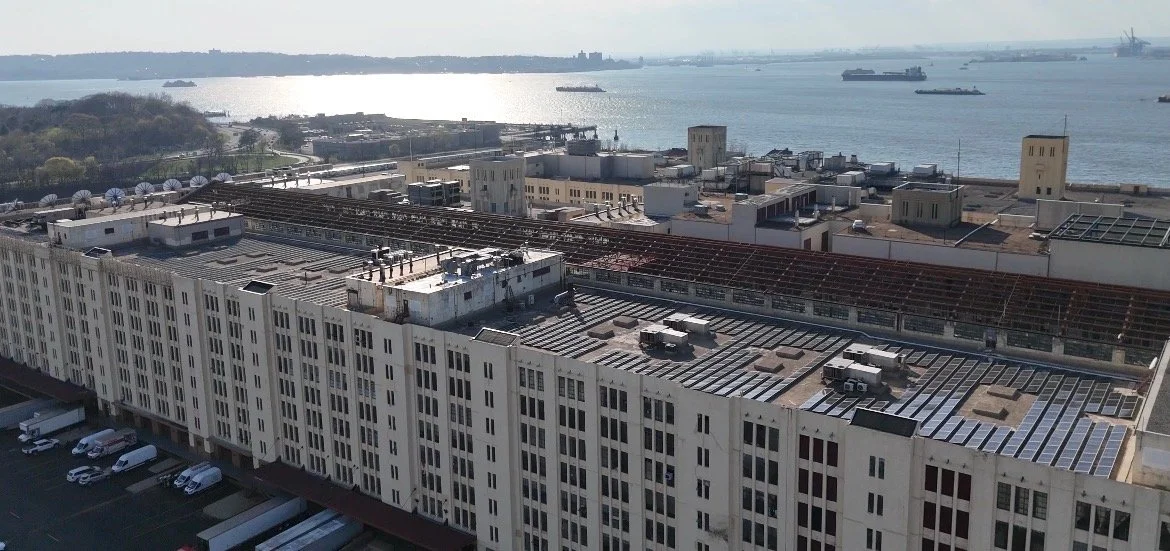
Sunset Park Solar on the Brooklyn Army Terminal rooftop is New York City’s first community-led solar project. Photo courtesy of UPROSE.
On the Grid
In the coming months, the team is working to turn Sunset Park into a special purpose district as part of “The GRID 2.0,” a 150-page Just Transition Plan for Sunset Park. New York City neighborhoods have received this designation since 1969 to retain certain aesthetics, mandate buffers between commercial and residential neighborhoods, and expand housing and economic opportunities. A special purpose district in Sunset Park would allow the community—not outsiders—to direct what’s happening on its waterfront.
It would also prevent history from repeating itself. In 2013, Jamestown, the developer behind Chelsea Market, and its investment firm partners decided to rebrand and expand Industry City. Without securing community buy-in, they “helicoptered in,” as Yeampierre put it, and transformed a 19th century waterfront industrial complex. “They decided we needed more bagel stores and bars on Third Avenue,” she said. “What we really could have used was a dedicated space for climate adaptation, mitigation, and resilience that would attract green manufacturing.”
But UPROSE didn’t stop fighting. In 2020 it stopped a rezoning that would have enabled additional expansion. That win helped the organization secure an offshore wind facility in 2024. And with the wind turbines, Yeampierre earned the respect of her one-time adversary.
Not long ago, she stood with Industry City’s owner, with whom she had fought for seven years. They looked at the water and the wind turbines slated for completion in 2027. The billionaire told her he hadn’t thought any of it was possible.
“I did,” Yeampierre told him, and then, without missing a beat, continued. “So, can we talk about your rooftops? Can we put solar arrays up there? And can we get access to your parking lot?”
It’s okay to fight, she explained, but then you have to make-up. And you should probably break bread. Hugging is good, too.
“If it’s in the interest of justice, we won’t write you off,” she said with a wink. “Besides, don’t we look like we have fun?”