
Why Civic Engagement is Sacred to Building and Preserving a Multiracial Democracy
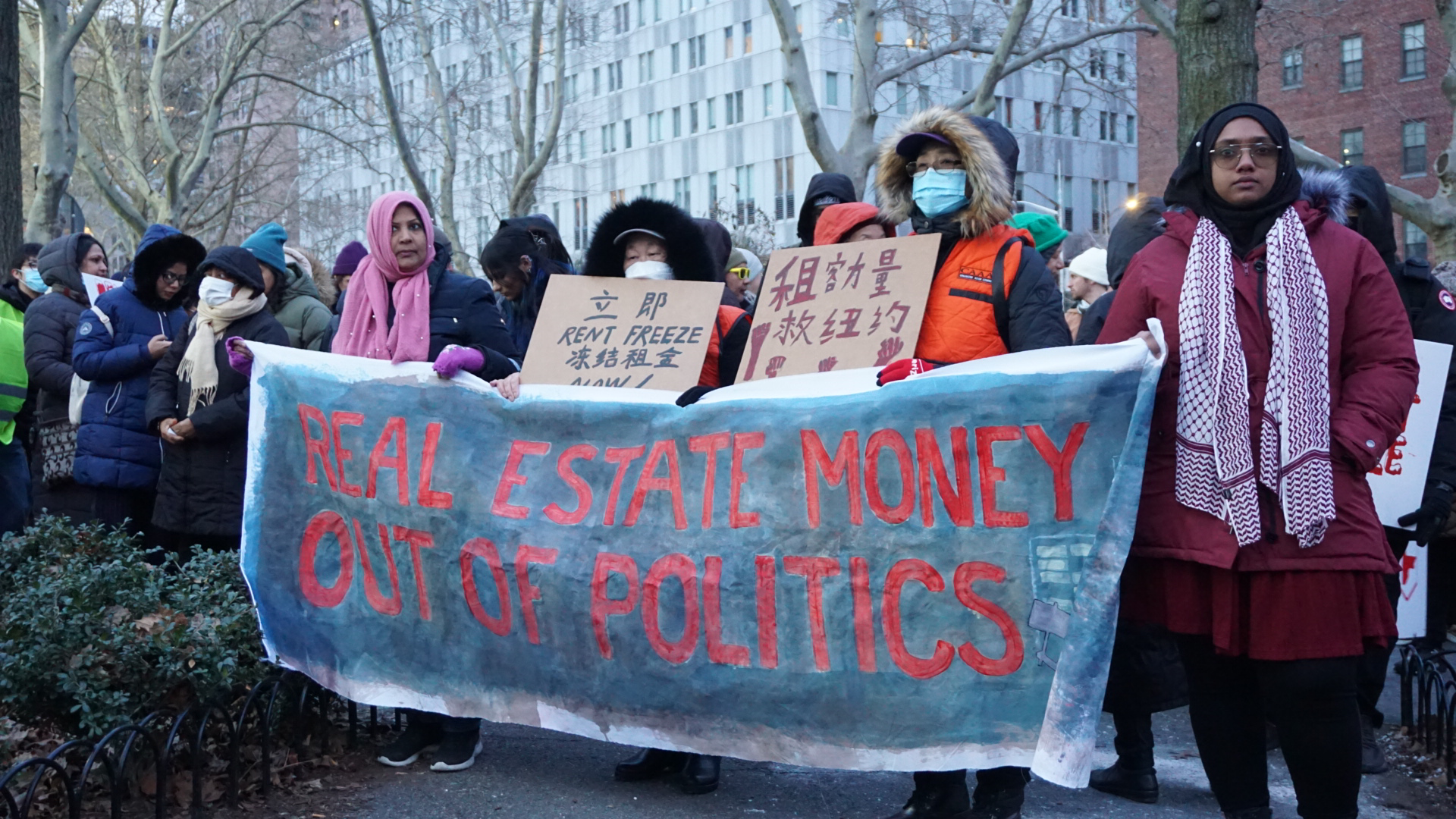
CAAAV leaders at the People's gala, held on the streets outside of the Real Estate Board of New York gala. Photo courtesy of CAAAV.
Wong Si Ping and Lee Si were part of the first wave of Chinese immigrants to the United States. They settled in San Francisco, opened a grocery store, and lived above it where their son Wong Kim Ark was born in the 1870s. Though economic competition and xenophobic legislation, including the Chinese Exclusion Act of 1882, drove the family back to China, Wong Kim Ark soon returned to California. For years he crossed continents without incident, but in the fall of 1895, California immigration officials denied him entry, detained him for months, and challenged his citizenship. None of this deterred him. Backed by his community and the Chinese Consolidated Benevolent Association, Wong fought back. Building on the foundation of the Fourteenth Amendment, which ensured citizenship rights for formerly enslaved Black people and their descendants, Wong’s case reached the Supreme Court. In 1898 a landmark decision in United States v. Wong Kim Ark affirmed birthright citizenship to anyone born in the United States—including the children of immigrant parents.
Today, Wong’s story has been summoned as the Supreme Court is expected to issue a ruling in Trump v. Barbara, which would deny automatic citizenship to the U.S. born children of undocumented or temporary status parents. His case remains as important as it was more than a century ago when it shined a blinding light on racial discrimination and why constitutional amendments must trump executive power. It is also a powerful reminder that democracy depends on participation from diverse groups; that community struggles for justice are deeply intertwined; and that protections for one group can pave the path for protections for everyone. Equally important, Wong’s legal battle also became the blueprint for Asian American civic engagement.
In honor of Asian American, Native Hawaiian, and Pacific Islander (AANHPI) Heritage month and its theme—“Power in Unity: Strengthening Communities”—we spoke to five formidable Scherman grantees about why civic engagement is the lifeblood of democracy. Julie Xu of CAAAV: Organizing Asian Communities, Huanjie Li of MinKwon Center for Community Action, Farzana Linda of Chhaya, Christina Baal-Owens of The National Asian Pacific Women’s Forum (NAPAWF), and Bethany Li of The Asian American Legal Defense and Education Fund (AALDEF) tell us how they’re engaging, educating, and empowering the fastest-growing group of eligible voters in the U.S.
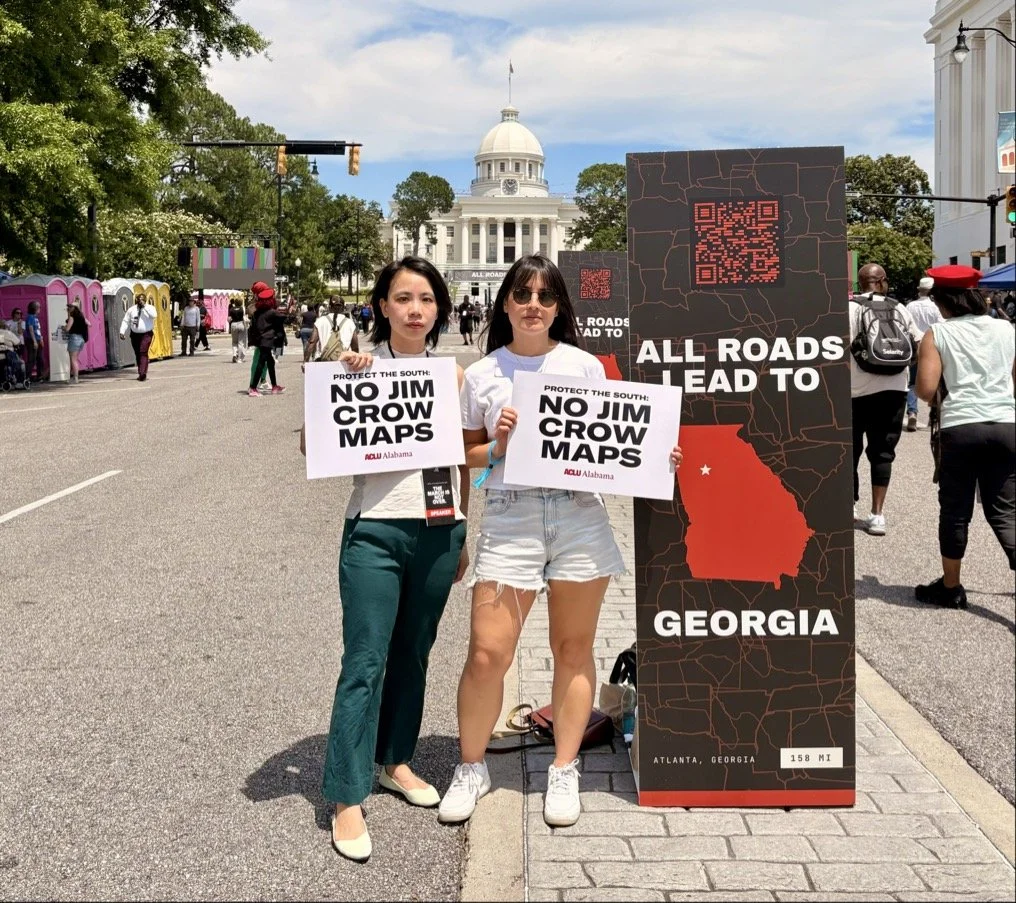
On May 16th, AALDEF's Bethany Li and Phi Nguyen joined the Legal Defense Fund and Black Voters Matter in Montgomery, Alabama to protest the Supreme Court’s harmful decision in Louisiana v. Callais. Photo courtesy of AALDEF.
How do you define civic engagement and why is it so important?
Huanjie Li (HL, MinKwon Center): Civic engagement is woven into our daily lives—from casual conversations about local issues to voting to advocacy to fighting for fair representation so our communities are fully seen and heard. We often start by providing services—everything from helping enroll people for benefits to form assistance to free legal representation. Then we move on to getting them registered to vote, providing information so they can make informed choices, and encouraging them to organize. Organizing can be something as simple as connecting with neighbors and strategizing how to fight rising rents.
Julie Xu (JX, CAAAV): For CAAAV, it’s about building the power of working-class Asian Americans, who are often misconceived as too small or not civically engaged enough to have political power. We believe that grassroots organizing is foundational to civic engagement and that everyday people need to be decisionmakers in their communities and government. This is the only way to have a true, working democracy.
Farzana Linda (FZ, Chhaya): Civic engagement provides people with a voice. It is one of the primary ways we can improve our material conditions and quality of life. It ensures everyone has a seat at the table—regardless of their status.
Christina Baal-Owens (C B-O, NAPAWF): Civic engagement is how marginalized people build power and hold systems accountable. It makes sure our communities are informed, organized, and able to advocate for ourselves and our families. It ensures people have a voice in decisions around health care, reproductive freedom, economic security, and immigrant rights. For our communities, it is often one of the few mechanisms to convert lived experience into policy influence and long-term governing power.
Bethany Li (BL, AALDEF): For AALDEF, civic engagement is closely tied to community education and offering information that our partners and people on the ground can use in their organizing work. Democracy requires a lot and has always depended on diverse communities working together, but that’s especially true right now.
Civic engagement goes beyond casting ballots, but can you explain why voting remains critical?
HL (MinKwon Center): Our position is that you’re not voting for yourself. You’re voting for the people who cannot vote. You’re voting for your relatives who don’t have legal status. You’re voting on behalf of your community. And it is not a right—it’s an obligation. We tell the adult students in our nationalization class that after they gain citizenship and get sworn in, they need to make voting a priority. We tell them to register. And we tell them that they shouldn’t just vote when they get a chance or when they have free time. They must make it a priority.
BL (AALDEF): Voting is the first access point to democracy. People must be able to vote for their voices to be heard. Like other historically marginalized communities, Asian Americans also experience voter suppression, and it’s often because of language access. If people show up to vote and can’t communicate, they’re discouraged and go home. We work in a lot of Section 203 jurisdictions where the Voting Rights Act mandates language assistance for minority groups so they can participate in the electoral process.
C B-O (NAPAWF): If communities cannot fairly access the ballot box, it’s harder to fight for affordable health care, reproductive freedom, fair wages, and protections for immigrant families.
Tell us about a goal or goals you’re focused on?
JX (CAAAV): We’re in the midst of a multiyear campaign for a four-year rent freeze. During the 2025 NYC mayoral campaign season, we popularized this idea and made it a core part of candidates’ campaigns. That was a major victory, and it’s become a top agenda for the Mamdani administration. Our goal is to make sure the freeze is implemented through the Rent Guidelines Board, which will make a final vote this June.
FL (Chhaya): Right now, we’re focused on deeper political education to ensure community members are equipped to understand the current political system and the different avenues for civic engagement. That includes calling elected officials, holding rallies and press conferences, joining or attending local community boards, attending hearings, collecting petitions, writing postcards, and meeting local and state officials. We make sure community members understand where candidates stand on a range of priority issues. And we’re demonstrating how civic participation and engagement can create change in varying housing issues—from displacement to gentrification to ending toxic home flipping.
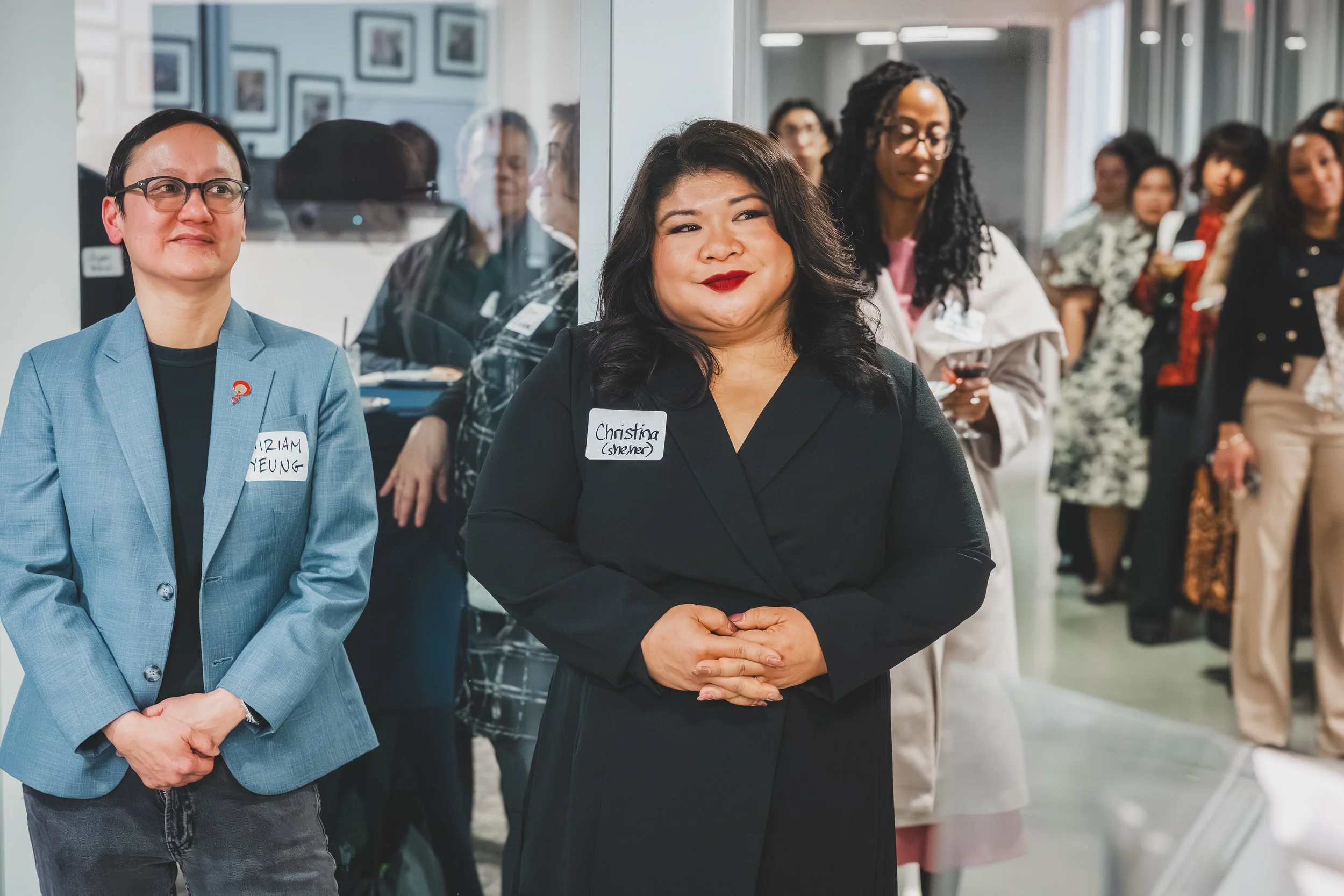
Christina Baal-Owens (right) and Miriam Yeung, NAPAWF board chair (left) attend a DC reception welcoming Christina as executive director. Photo courtesy of NAPAWF.
What are some of the challenges in your civic engagement work?
HL (Minkwon Center): Civic engagement requires a culture shift. While doing poll monitoring at local sites, I remember seeing so many white parents bringing their kids to the ballot box. This just wasn’t the norm in our community. I hope we can change that, but it’s hard because people are understandably frightened. ICE is in our neighborhoods, and many of our friends and family are undocumented. People are worried about facial recognition. If they participate in a rally, will they be flagged? Will their image be uploaded to a database and traced to their relatives? We’re asking people to come to trainings about ICE when they’re terrified. And it’s hard to counter so much misinformation that’s designed to get clicks.
BL (AALDEF): We’re up against the most powerful forces of white supremacy any of us have ever experienced. One of the strategies is to divide communities and pit us against each other, and that’s playing out in a lot of different fights. Take affirmative action. Polling shows that the majority of Asian Americans support it, but the predominant narrative is informed by a very small but vocal group who say they’re against it. This is complicated by the fact that Asian Americans occupy a very precarious place in America’s racial structure. No matter what we do, we’re always labeled as “other.” We saw that during segregation and the Civil Rights Movement. We need to stand in solidarity with all communities of color. So, during the anti-Asian violence movement, we were very deliberate about pushing back against media narratives that were falsely blaming Black communities for the violence and stoking divisions.
C B-O (NAPAWF): Targeted disinformation, limited in-language information, and insufficient civic and health information create growing confusion around reproductive health care, voting rights, and immigration policies. Our recent “Beyond the Labels” research reinforced this reality. For example, our study found that while 84 percent of AAPI women believe people should be able to make their own abortion decisions without government interference, many still underestimate how severe abortion criminalization has become and how these policies could harm them.
What’s giving you hope in a very difficult moment in U.S. history?
HL (MinKwon Center): We’re seeing an overall surge in youth voter participation and a major jump in AAPI-heavy districts. I’ve never seen young people so excited about an election and there’s great opportunity for them to pass on—or pass up—a culture of civic engagement to their parents and grandparents.
JX (CAAAV): Despite challenges, we’re growing the political power of working-class Asian immigrants. We’re doing it by reaching new neighborhoods in New York City and by increasing our membership, continuing to build leadership among existing members, and developing new members into community leaders.
C B-O (NAPAWF): Our communities have always been a part of the fight for justice in this country—even when that history is overlooked. Asian Americans stood alongside Black organizers during the Civil Rights Movement. Filipino farmworkers helped lead the Delano Grape Strike. And in recent years, AANHPI voters—particularly women voters—have become a particularly powerful force in elections. In 2020 and 2022, we saw historic levels of outreach and engagement with AANHPI voters in battleground states because our communities are organizing, voting, and demanding to be heard.